
Executors and families sorting through a loved one’s personal belongings may encounter prosthetic limbs, components, and related supplies. These items can be difficult to dispose of, but many usable components can be given a second life through organizations that collect and repurpose prosthetic equipment.
Common questions
- Where can I donate a prosthetic leg?
- Where can I donate a prosthetic arm?
- Where can I donate prosthetic devices?
- Where can I donate prosthetic equipment?
In this guide: What can be donated · Donation programs · Additional guidance
Good news for executors and families

As PENTA explains, hundreds of thousands of still-functional prosthetic devices are discarded in the United States. At the same time, many people around the world lack access to the materials, professional care, and equipment needed for a properly fitted prosthesis. There are organizations working to bridge that gap by collecting usable devices and redistributing their components.
There’s an army of dedicated individuals and organizations working to meet the demand for prosthetic equipment by recovering usable prostheses, components, and parts from the United States. The good news is that with a little direction, executors and families can get equipment into these channels instead of sending it to a landfill.
Donation programs inspect, sort, and often disassemble the devices they receive. A custom-fitted prosthesis is rarely reusable as a complete unit, but the feet, knees, connectors, and other working parts may serve another person. Some organizations provide prepaid shipping labels, while others ask the donor to cover shipping.
It is a practical way to help someone else while moving the estate cleanout forward. Win-win-win.
“In many second and third world countries the challenges are multiple. Resources to attain a prosthesis are often scarce. This can be from one’s ability to pay and from the ability to attain the materials and parts that are needed. In addition, prosthetists are often rare and one may have to travel a long distance to see one.”
Eric Shoemaker, MS, CPO
Executive Director of Clinical Operations, Ability Prosthetics and Orthotics, LLC (original 2021 interview)
Prosthetic equipment and components that may be accepted
Always check the receiving organization’s current guidelines before donating or shipping. Acceptance requirements differ, particularly for used soft goods and upper-limb prostheses.
- Used prosthetic limbs, particularly lower-limb devices
- Prosthetic feet and knees, in usable condition and in sizes accepted by the recipient
- Modular components, such as tube clamps, pyramids, socket adapters, pylons, and foot adapters
- Unused liners, sleeves, prosthetic socks, and related accessories
- Other parts or fabrication supplies, when specifically requested by the receiving program
Before donating: Do not send rusted, broken, leaking, or heavily damaged components. Custom-made sockets usually cannot be reused independently; ask a prosthetist or the recipient organization whether they should be removed. Do not assume used liners, socks, or sleeves can be accepted. If you have a prosthetic arm or hand, confirm that the organization accepts upper-limb equipment before shipping.
Organizations that receive prosthetic donations
PENTA (Penta Medical Recycling)

PENTA helps bring prosthetic care to underserved communities by collecting functional used prosthetic equipment, screening its components, and working with clinical partners abroad. Donations are inspected and, in many cases, disassembled so that usable parts can be matched to an individual’s needs.
PENTA also works with partners on the practical issues surrounding long-term prosthetic care, including access to trained prosthetists, follow-up care, and reliable supplies.
From our original 2021 reporting: At that time, PENTA described supporting under-resourced communities in 12 countries in Southeast Asia, Africa, and Latin America, working with ministries of health, prosthetics schools, teaching hospitals, and independent clinics. The organization described country-specific needs, including mobile technicians in rural Pakistan and a teaching-hospital partnership in Thailand. These examples illustrate why logistics, training, and ongoing care are every bit as important as collecting the physical equipment.
“The Limb means so much to the recipient and recipient’s family. In many countries, there is a stigma attached with limb loss and the mere presence of an artificial limb often does more than its functional purpose, and provides an individual with a means to cancel the stigma, and provide a sense of completeness.”
— Henry Iseman, Executive Director, PENTA (original 2021 interview)
How to donate: PENTA offers a prepaid UPS shipping label through its donation page. It accepts qualifying gently used lower-limb prosthetic equipment and new supplies, including liners and socks. It asks that standalone sockets not be donated. Review its guidelines and obtain the label before packing.
Impact stories: PENTA Impact
Charity Navigator: PENTA profile
ROMP (Range of Motion Project)

ROMP works to provide prosthetic care to underserved patients and improve access to mobility.
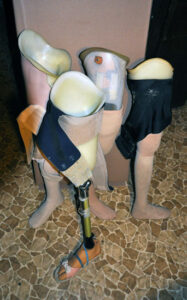
ROMP’s Components for a Cause recycling program collects qualifying prosthetic parts and channels them into clinical operations in Guatemala and Ecuador. Working components are checked, cleaned, entered into inventory, and used to support individualized prosthetic care.
ROMP particularly seeks certain feet, knees, liners, pediatric components, and adapters. It asks donors not to send damaged or heavily worn items, sockets, shoes, orthotic braces, or some larger foot sizes. Because its needs change, the current recycling page is the best place to confirm whether a particular item is useful.
The work goes beyond supplying components: long-term prosthetic care may include gait training, physical therapy, adjustments, and repair. In its original interview for Executorium, ROMP described the environmental and humanitarian value of recovering usable components.
From our original 2021 reporting: ROMP described its Components for a Cause goal of collecting more than 5,000 pounds of components annually and reported having delivered more than 4,000 prosthetic devices since 2005. The organization also described a U.S. Assistance Program serving qualified patients through enrolled prosthetists. These were historical program descriptions and figures from the original article; readers should consult ROMP for current programs and impact totals.
“Components for a Cause (C4C) is beneficial all around. Recycling prosthetic waste provides quality mobility devices to those who need it most, keeps waste out of landfills, allows ROMP practitioners to make a variety of clinical decisions, and allows ROMP to run cost effective programs in the Americas. It is an essential part of our mission and impact.”
— David Krupa, CP, ROMP co-founder and Executive Director (original article)
How to donate: Collect and securely box accepted components, then request a shipping label through ROMP’s current recycling page. ROMP states that it provides a free label. Its instructions and acceptance criteria should be checked before shipping.
ROMP Components for a Cause: recycling instructions and shipping label
Charity Navigator: ROMP profile
Limbs for Life

Working with prosthetic clinics and clinicians, Limbs for Life helps people who otherwise cannot afford prosthetic care. Its LEGacy Room receives donated limbs and components that can be used for repairs, replacement parts, and other qualifying needs. The organization also shares certain components through international partners.

From our original 2021 reporting: In 2020, its 25th year, Limbs for Life reported funding its highest number of prosthetic limbs to that point. The organization described distributing approximately 65% of its donated parts inventory within the United States and the remainder internationally. Its LEGacy Room, then reported as 1,800 square feet, handled thousands of parts annually; in the first half of 2021 alone, the organization reported receiving 4,200 components and sending out 4,700. These are historical figures from the original reporting, not current annual statistics.
For context, Limbs for Life’s 2019 results, cited in the original article, included 230 U.S. amputees helped with prosthetic legs, 5,800 parts recycled and redistributed, and information or referral services to 1,475 people. These are historical 2019 figures, not current results.
“Donations of used limbs and parts and the unique partnership with over 300 clinics in the U.S. allow Limbs for Life to be the safety net for amputees in need. Whether the need is a new limb or a replacement part or repair, Limbs for Life stands in the gap to get amputees back on their feet and back to living life. Your donations are a priceless gift to our mission.”
— Shelley Dutton, Development Director, Limbs for Life (original 2021 interview)
How to donate: Limbs for Life accepts used prosthetic limbs from within the United States, appropriate component parts, and unused only liners, socks, sleeves, and similar textile accessories. It does not accept used textile products, orthotics, durable medical equipment, or general medical supplies. Donors pay shipping and should include the organization’s current in-kind donation form or identifying contact information with the package.
Charity Navigator: Limbs for Life profile
Additional guidance for donating prosthetic equipment
Amputee Coalition

The Amputee Coalition does not operate a prosthetic recycling program, but it provides useful guidance and identifies organizations that receive donations. Executorium also acknowledges the Coalition’s help with the original research for this article.
Its Prosthetic Limb Donations fact sheet explains why damaged components, used soft goods, standalone sockets, and many types of general medical equipment should not be sent to prosthetic recycling programs. It also lists donation organizations and advises contacting each program before shipping.
IsBrave — Where to Donate Prosthetics and Supplies for Amputees

IsBrave is an online resource offering practical information, guides, and personal perspectives for people navigating limb loss and prosthetic care.

Its Where to Donate Prosthetics and Supplies for Amputees guide is particularly useful for executors and families faced with the practical question of what to do with a loved one’s prosthetic equipment. It explains which parts of a prosthesis are typically reusable, identifies donation organizations, and walks readers through preparing, packing, and sending equipment. It also addresses donation receipts and tax considerations.
For anyone sorting through a prosthetic limb or a box of specialized components during an estate cleanout, this is a helpful companion to the organization listings above.
Read the guide: Where to Donate Prosthetics and Supplies for Amputees — IsBrave
A note on charitable contributions
Donations of qualifying personal property to eligible charitable organizations may have tax implications, but a deduction is not automatic. The treatment can depend on who owns the property, who makes the gift, the receiving organization, and applicable tax rules. An organization may acknowledge receipt without assigning a value to donated equipment. Executors should discuss the estate’s circumstances with an accountant or tax adviser.
See also: Executorium’s guide to IRS Publication 561: Determining the Value of Donated Property, or consult IRS Publication 561 directly.
Original reporting and acknowledgments

Contributors to the original 2021 article:
Henry Iseman, Executive Director, PENTA
Shelley Dutton, Development Director, Limbs for Life
Lauren Panasewicz, Director of Development, ROMP
Aaron Burnell, Amputee Coalition
Eric Shoemaker, MS, CPO, Executive Director of Clinical Operations, Ability Prosthetics and Orthotics, LLC
Executorium also thanks Ability Prosthetics and Orthotics, LLC for its assistance researching and assembling the original article.